Source Non Stick Flexible Baking Tray for Bread Pizza Cake
Find 30 non stick flexible baking tray options from Chinese manufacturers. Compare specifications including aluminum alloy construction, Teflon coating, and various sizes like 600x400mm for bread, pizza, and cake production.
Key considerations
Products List


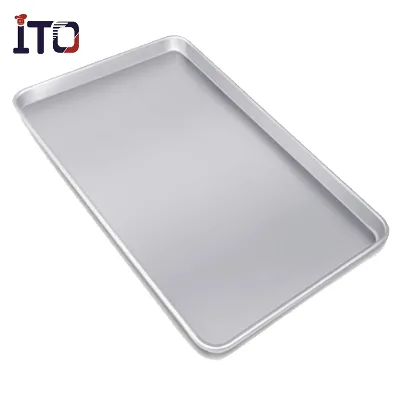


Comprehensive Sourcing Guide
Strategic Sourcing Guide for Non-Stick Flexible Baking Trays
Understanding Product Specifications and Material Composition
When sourcing non-stick flexible baking trays, the primary objective is to identify products that balance thermal conductivity with structural integrity. Based on available market data, the core material composition for these items is predominantly Aluminum Alloy. This material choice is critical because aluminum offers superior heat distribution compared to steel, ensuring even baking results for items such as bread, pizza, cake, and biscuits. The thickness of the material is a decisive factor in performance; observed specifications indicate a range of 0.7mm to 1.0mm for the aluminum alloy construction. A thickness of 1.0mm generally suggests a more rigid tray capable of supporting heavier doughs without warping, whereas 0.7mm variants may offer greater flexibility but require careful handling to prevent deformation during high-temperature cycles.
The surface treatment is equally vital for the "non-stick" claim. The supplied data explicitly identifies Teflon coating as a standard processing method for these trays. This coating is designed to facilitate easy release of baked goods and simplify the cleaning process, which is a primary requirement for commercial kitchens and industrial bakeries. However, buyers must verify the specific application process of this coating, as the durability of Teflon depends heavily on the curing temperature and the quality of the primer used before the topcoat application.
Dimensional consistency is another key specification. The standard size observed in the market is 600 x 400 mm (or 60 x 40 cm), which aligns with international baking sheet standards. However, the market also supports a wide variety of custom and alternative sizes. Observed data lists specific models with dimensions such as 46 x 66 cm, 46 x 72 cm, 60 x 80 cm, and 80 x 100 cm. Some suppliers offer a modular sizing system labeled T1 through T6, covering dimensions from 400 x 600 mm up to 800 x 1000 mm. This variability allows buyers to match trays precisely to their existing oven racks and production lines. The depth of the tray also varies, with specifications noting heights of 20 mm and 30 mm. The 30 mm depth is typically preferred for products requiring higher volume containment, such as deep-dish pizzas or large cakes, while the 20 mm profile suits standard sheet cakes and cookies.
Compliance, Certification, and Safety Standards
In the food processing industry, compliance with safety standards is non-negotiable. While specific certification documents like ISO 9001 or ASTM A510 are mentioned in broader industry contexts, buyers must not assume that every listed product automatically satisfies these standards without explicit verification from the supplier. The procurement process requires direct confirmation that the aluminum alloy used meets food-grade safety requirements and that the Teflon coating is compliant with relevant food contact regulations.
Buyers should request documentation proving that the materials used in the baking trays are free from harmful substances such as PFOA (perfluorooctanoic acid), which has been phased out in many jurisdictions but remains a concern in unregulated markets. The "Non-Stick" attribute listed in the product data implies a specific functional capability, but the safety of the coating under high heat is a separate verification point. It is essential to confirm that the coating remains stable at the maximum operating temperatures of the intended ovens, which can often exceed 250°C.
Furthermore, the origin of the product plays a role in compliance. The data indicates that these products originate from major manufacturing hubs in China, specifically Shanghai and Guangzhou. While these regions have robust manufacturing ecosystems, the regulatory oversight can vary between factories. Buyers should ensure that the supplier can provide a Certificate of Analysis (CoA) or a Declaration of Conformity (DoC) that specifically addresses food safety standards for the region of import. For instance, if importing into the European Union, the product must comply with EU Regulation No 10/2011 regarding plastic materials and articles intended to come into contact with food, even if the primary material is metal, as the coating is a polymer. Similarly, for the United States, compliance with FDA regulations is mandatory.
Cost Drivers and Pricing Dynamics
The pricing of non-stick flexible baking trays is influenced by several distinct variables. The observed price range in the market spans from $0.91 to $280 USD per unit. This wide disparity is not indicative of quality alone but reflects differences in size, thickness, coating quality, and order volume. The lower end of the price spectrum likely corresponds to smaller, thinner trays (0.7mm) with standard Teflon coatings, while the higher end may represent larger, thicker (1.0mm) trays with premium coating systems or specialized customizations.
Minimum Order Quantity (MOQ) is a significant cost driver. The data shows an MOQ range of 1 to 500 units. For small businesses or those testing new product lines, suppliers offering an MOQ of 1 allow for low-risk sampling. However, the unit price for such small orders will naturally be higher due to the fixed costs of production setup and packaging. Conversely, buyers committing to an MOQ of 500 or more can expect significant economies of scale, potentially bringing the unit cost closer to the lower end of the observed range.
Customization is another factor that impacts cost. The product data confirms that customization is available for both dimensions and potentially other attributes. Custom sizes, such as the 46 x 66 cm or 80 x 100 cm variants, often require dedicated tooling or production runs, which can increase the per-unit cost compared to standard 600 x 400 mm trays. Additionally, the packaging method affects the final landed cost. Options include Export Cartons, Plywood Cases, or standard Carton Boxes. Plywood cases are more expensive but offer superior protection for international shipping, reducing the risk of damage during transit. Buyers must weigh the cost of packaging against the potential loss from damaged goods.
Typical Applications and Operational Use Cases
The versatility of non-stick flexible baking trays makes them suitable for a broad spectrum of culinary applications. The product specifications explicitly list usage for bread, pizza, cake, and biscuits. The non-stick surface is particularly beneficial for high-sugar content items like cakes and pastries, which are prone to sticking to traditional metal surfaces. The flexibility of the tray, implied by the "flexible" keyword in the search term and the nature of aluminum alloy construction, allows for easier removal of baked goods without the need for excessive scraping, which can damage the product or the tray.
In commercial settings, the trays are often used in conjunction with electric ovens. The data mentions a voltage of 220V and an electric power source, indicating that these trays are designed for use in standard commercial electric baking equipment. Some advanced setups may include timing devices, which, while not a feature of the tray itself, suggest an integrated workflow where the tray is used in automated or semi-automated baking lines. The different sizes (T1-T6) allow for efficient use of oven space, enabling bakeries to bake multiple batches of different products simultaneously.
The "Plain Tray" and "Toast Sandwich Tin" attributes suggest that these trays are not limited to baking but can also be used for toasting and sandwich preparation. The non-stick coating ensures that sandwiches can be toasted evenly without the bread sticking to the metal, preserving the texture and appearance of the final product. For cupcake and hamburger trays, the specific dimensions and depth are crucial. The data lists specific models for cupcake trays and hamburger trays, indicating that the non-stick feature extends to smaller, specialized baking vessels as well.
Supplier Evaluation and Origin Verification
Selecting the right supplier requires a rigorous evaluation process that goes beyond price comparison. The product data identifies two primary origins: Shanghai and Guangzhou. Both cities are major manufacturing centers, but they may host different types of suppliers. Shanghai is often associated with higher-tech manufacturing and export-oriented facilities, while Guangzhou has a vast network of trading companies and manufacturers. Buyers should verify the specific factory location rather than relying solely on the city name, as the quality control standards can vary significantly between facilities.
When evaluating suppliers, buyers should look for transparency regarding the production process. The data mentions "Export Carton or Plywood Case" as packing options, which implies that the supplier is experienced in international logistics. However, buyers should request photos of the actual production line and the packaging process to ensure that the trays are handled correctly to prevent scratching the non-stick coating. The presence of a "Customization" attribute suggests that the supplier has the capability to produce non-standard sizes, but buyers must verify the lead time for these custom orders.
It is also important to assess the supplier's ability to provide consistent quality. The data lists multiple product models (MH11111, M11111, MH-11111, 12071, 14120, T1-T8), which indicates a diverse product portfolio. A supplier with a wide range of models may have more experience in handling different specifications, but buyers should ensure that the specific model they are ordering has a proven track record. Requesting samples from the specific model number is a prudent step to verify the thickness, coating adhesion, and dimensional accuracy before placing a large order.
Quality Control and Long-Term Procurement Considerations
Quality control (QC) is paramount when sourcing non-stick baking trays. The durability of the Teflon coating is the most common point of failure. Buyers should implement a QC protocol that includes checking for coating uniformity, adhesion strength, and resistance to scratching. Visual inspection of the coating for bubbles, peeling, or uneven application is a basic requirement. Additionally, thermal cycling tests should be conducted to ensure that the coating does not degrade or release fumes at high temperatures.
Long-term procurement considerations involve the lifecycle of the product. A 1.0mm thick tray is likely to have a longer lifespan than a 0.7mm tray, making it a better investment for high-volume operations. However, the cost-benefit analysis must include the frequency of replacement. If the non-stick coating wears out quickly, the savings from a cheaper, thinner tray may be negated by the need for frequent replacement. Buyers should also consider the environmental impact of the product. Aluminum is recyclable, but the Teflon coating complicates the recycling process. Suppliers who can provide information on the recyclability of their products or offer take-back programs may be more attractive partners.
The packaging method also plays a role in long-term quality. Plywood cases offer better protection than standard cartons, reducing the risk of damage during shipping. For international buyers, the cost of damaged goods can be significant, so investing in robust packaging is often a wise decision. Finally, buyers should establish a clear communication channel with the supplier for handling any quality issues that arise post-delivery. A supplier that is responsive to QC concerns and willing to replace defective units is essential for maintaining a reliable supply chain.
Comparison of Key Product Attributes
To assist in decision-making, the following table summarizes the key attributes observed in the market data for non-stick flexible baking trays. This comparison highlights the variations in material, size, and customization options that buyers should consider.
| Attribute | Standard Observation | Range / Variations | Notes for Procurement |
|---|---|---|---|
| Material | Aluminum Alloy | 0.7mm to 1.0mm Thickness | Thicker (1.0mm) offers better rigidity; thinner (0.7mm) is more flexible. |
| Coating | Teflon | Non-Stick | Verify food-grade safety and PFOA-free status. |
| Standard Size | 600 x 400 mm | 4060cm, 4666cm, 6080cm, 80100cm | Match to oven rack dimensions; custom sizes available. |
| Depth | 20 mm - 30 mm | 20mm, 30mm | 30mm preferred for high-volume items; 20mm for standard sheets. |
| Origin | China | Shanghai, Guangzhou | Verify factory location and export experience. |
| Packaging | Export Carton / Plywood | Carton Box, Plywood Case | Plywood offers better protection for international shipping. |
| MOQ | Variable | 1 to 500 units | Lower MOQ for sampling; higher MOQ for cost efficiency. |
| Customization | Available | Yes | Confirm lead times and tooling costs for custom sizes. |
By carefully analyzing these attributes and adhering to the verification steps outlined above, buyers can secure high-quality non-stick flexible baking trays that meet their operational needs while minimizing risk and ensuring compliance with safety standards. The diversity of the market allows for tailored solutions, but the responsibility lies with the buyer to validate the specific claims and specifications of each supplier.
FAQs
What materials are used for non stick flexible baking trays?
These trays are primarily constructed from aluminum alloy. The material thickness typically ranges from 0.7mm to 1.0mm, with 1.0mm offering greater rigidity for heavier doughs while 0.7mm provides more flexibility.
Can I customize the size of the baking tray?
Yes, customization is available for both dimensions and specific models. Standard sizes include 600 x 400 mm, but alternative sizes like 46 x 66 cm or 80 x 100 cm can be produced upon request.
How thick is the aluminum alloy material in these trays?
The observed thickness of the aluminum alloy material varies between 0.7mm and 1.0mm. Thicker 1.0mm trays are better for supporting heavy loads without warping during high-temperature baking cycles.
What coating is applied to ensure the non-stick surface?
The trays feature a Teflon coating to facilitate easy release of baked goods. This surface treatment simplifies cleaning and is essential for preventing sticking during the baking of items like bread and pizza.
Which locations are the primary origins for these products?
The products originate from major manufacturing hubs in Shanghai and Guangzhou, China. Buyers should verify the specific factory location to ensure quality control standards meet their import requirements.
What are the standard packaging options for export?
Export packaging options include standard carton boxes, export cartons, or plywood cases. Plywood cases offer superior protection for international shipping but may increase the overall landed cost compared to standard cartons.
Can I find trays with specific dimensions like 40 by 60 cm?
Yes, standard dimensions such as 40 x 60 cm are available alongside other sizes like 60 x 80 cm. The product line includes various models with different depths, such as 20 mm or 30 mm heights.